White Paper
08/24/2026
Campus Consortium Foundation
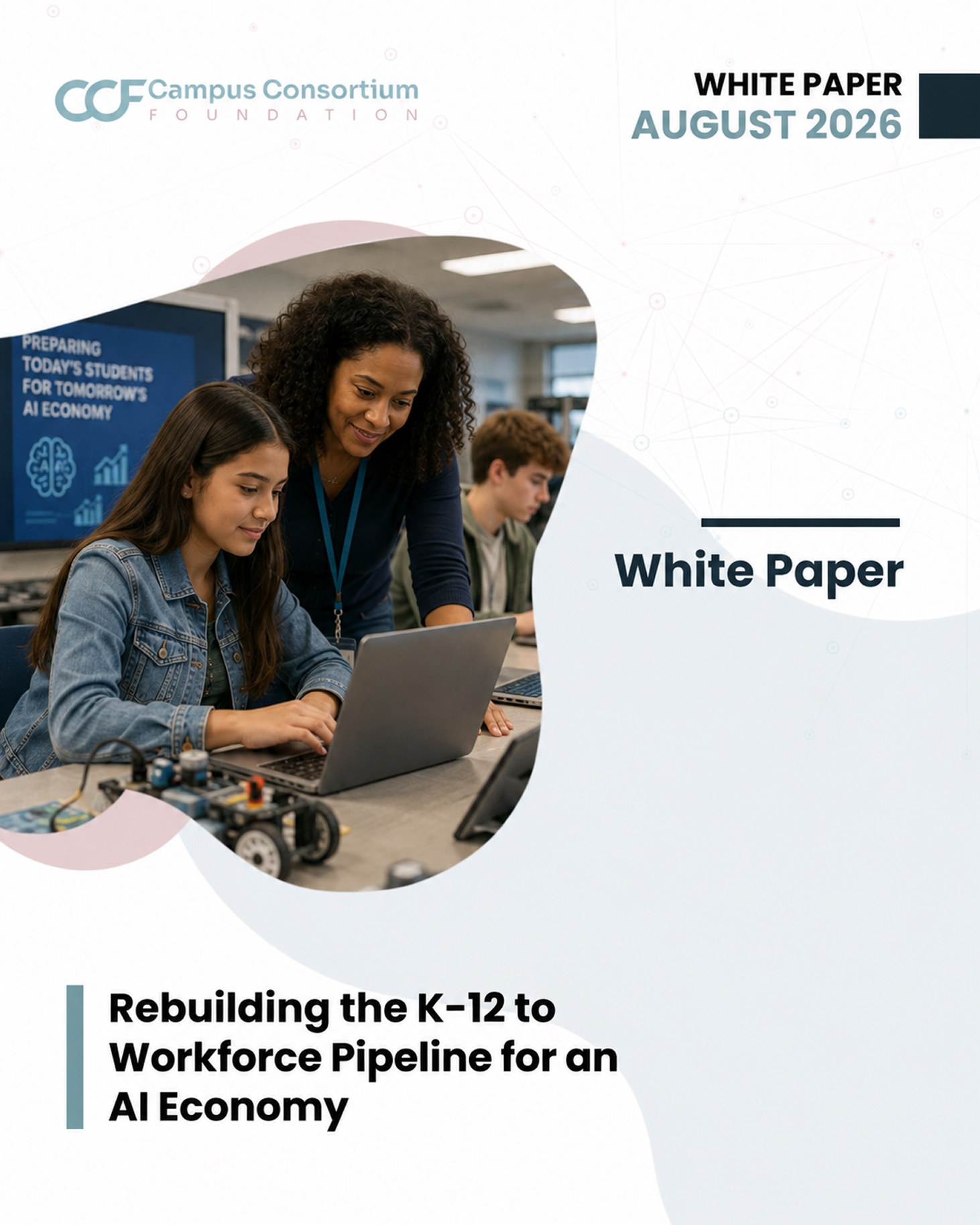
Rebuilding the K-12 to Workforce Pipeline for an AI Economy
Why Read This Research
The skills employers need are changing faster than the K-12 education system is adapting. Students are graduating into an AI-driven economy while facing gaps in mathematics, computer science, AI literacy, career exposure, and workforce-ready skills.
This research examines where the K-12-to-workforce pipeline is breaking down and what educators, policymakers, workforce leaders, and employers can do to rebuild it. It introduces a practical framework for aligning curriculum, teacher capacity, CTE, AI fluency, and employer partnerships around the skills students will actually need to succeed.
Key Questions Answered
- What skills are employers demanding in an increasingly AI-driven economy?
- Where does the current K-12 system fall short of those workforce expectations?
- How significant is the AI literacy and computer science education gap?
- Why are curriculum, teacher shortages, and career pathways weakening the pipeline?
- Which workforce-ready competencies should schools prioritize?
- How can districts and states measure their alignment with employer needs?
- What does an integrated, AI-ready K-12-to-workforce pipeline look like?
Features
- Research Focus: K-12 Education, AI Literacy, Workforce Readiness, CTE, Computer Science, Employer Alignment
- Future Education Impacts: Curriculum Design, Teacher Capacity, Career Pathways, Workforce Development, Employer Partnerships, Economic Mobility
- Authors: Campus Consortium Foundation Research Team
- Research Availability: August 2026
Table of Contents
- Executive Summary
- The Broken Pipeline
- Where the Pipeline Breaks
- The Skills Architecture
- The Pipeline Maturity Spectrum
- State and District Models
- The Accountability Map
- Strategic Frameworks and Decision Tools