Campus Consortium Foundation
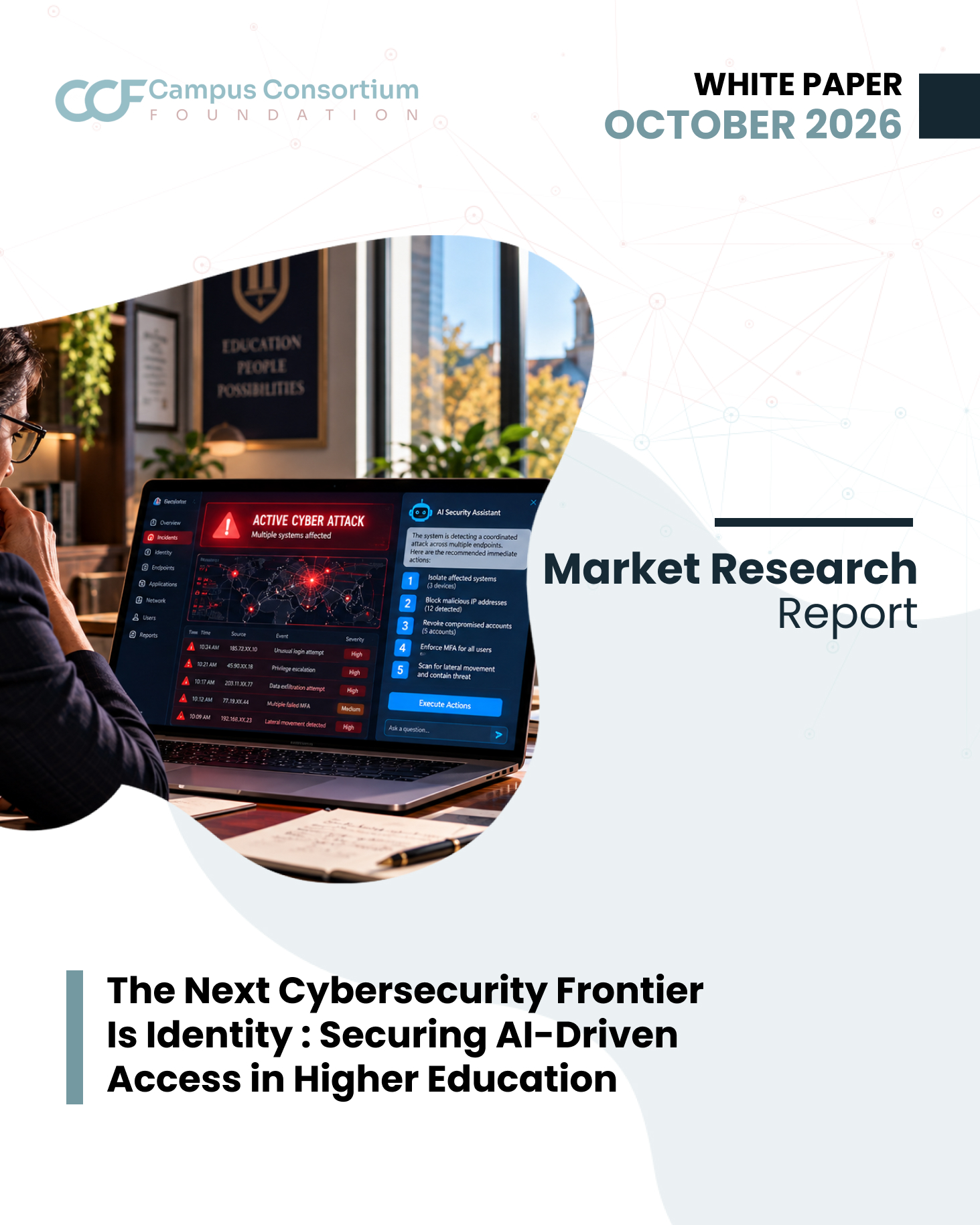
The Next Cybersecurity Frontier Is Identity : Securing AI-Driven Access in Higher Education
Why Read This Research
Identity is becoming a central cybersecurity challenge in higher education as AI agents, service accounts, API keys, and other non-human identities expand across campus systems. This research examines the market shift, growing identity risks, regulatory requirements, technology maturity, and rapid vendor consolidation shaping campus identity security through 2030.
The report goes beyond traditional IAM and MFA to examine non-human and agentic identity governance, phishing-resistant authentication, higher-ed federation, market economics, vendor dynamics, and institutional readiness. It provides market forecasts, competitive analysis, a CCF vendor evaluation framework, and strategic implications for higher-education leaders.
Key Questions Answered
- Why is identity becoming a critical cybersecurity frontier in higher education?
- How is AI creating new human and non-human identity risks?
- How large is the identity security market, and how fast is it growing?
- Where are identity security budgets and technology adoption shifting?
- How are vendor consolidation and platform convergence changing the market?
- What role do MFA, passkeys, Zero Trust, and identity governance play?
- What regulatory requirements are shaping institutional identity strategies?
- How should institutions evaluate identity security platforms and vendor viability?
- Where are the biggest market opportunities and white spaces through 2030/31?
- What should higher-education leaders prioritize in their identity roadmap?
Features
- Market Intelligence: Market size, growth, segmentation, drivers, barriers, and 2030/31 outlook
- Identity Analysis: IAM, SSO, MFA, IGA, PAM, non-human identity, and agentic AI governance
- Technology Maturity: HPasskeys, phishing-resistant authentication, Zero Trust, identity threat detection, and emerging technologies
- Vendor Landscape: Platform consolidation, identity specialists, higher-ed federation, and competitive dynamics
- Buyer Guidance: Vendor evaluation, integration, interoperability, compliance, governance, and vendor viability
- Institutional Fit: Research universities, four-year institutions, community colleges, HBCUs/MSIs, online institutions, and different campus sizes
- Risk & Regulation: AI-agent access, credential sprawl, ransomware, GLBA, NIST, NIH requirements, and identity maturity
- Future Outlook: Market opportunities, white spaces, emerging technologies, risks, strategic implications, and 2026–2030/31 scenarios