Campus Consortium Foundation
The Invisible Retention Layer: How Digital Access Shapes Student Persistence
Why Read This Research
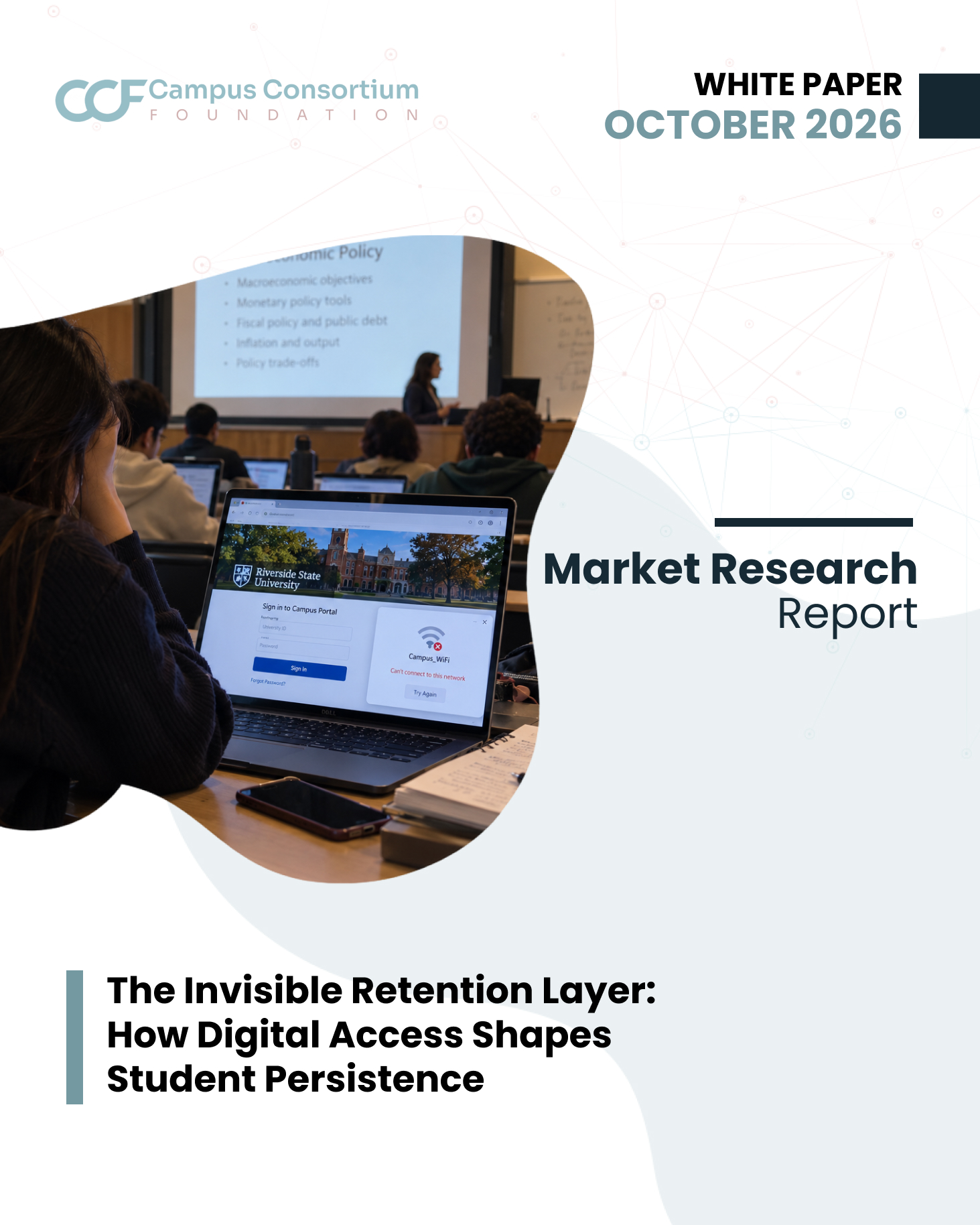
Digital access has become an invisible part of student persistence. A student may have a smartphone but no reliable broadband, share a device, lose access to an account, encounter an inaccessible course site, or need support outside office hours. These failures can look like disengagement or attrition even when the student intends to continue. This research examines the full digital access chain connectivity, devices, sign-in, accessibility, support, and access signals and how colleges can make these barriers visible.
The report goes beyond connectivity to examine market size and economic opportunity, student and institutional segments, online-learning outcomes, technology maturity, evidence on access interventions, fragmented ownership, solution archetypes, buyer priorities, accessibility requirements, emerging technologies, market opportunities, risks, and 2026–2030 scenarios. It provides a vendor-neutral framework for evaluating digital-access solutions while highlighting where evidence is strong, where it is limited, and what institutions should measure before investing.
Key Questions Answered
- How do connectivity, devices, sign-in, accessibility, and support shape the student persistence journey?
- How large is the digital-access opportunity, and what is the economic value of reducing access friction and improving retention?
- Which student groups, institution types, delivery modes, and access barriers face the greatest risk?
- What evidence shows that devices, connectivity, digital support, and accessibility interventions improve student outcomes?
- Where does digital access failure become a persistence risk, and what evidence is still missing?
- Which solution archetypes offer the strongest balance of evidence, reach, speed, low burden, equity, and measurability?
- How are online learning growth, accessibility regulation, funding changes, and evolving student expectations reshaping institutional priorities?
- What market opportunities, technology shifts, risks, and adoption scenarios should higher-education leaders prepare for through 2030?
Features
- Market Intelligence: Market size, adjacent software categories, economic opportunity, friction costs, retention value, market drivers, barriers, and 2026–2030 scenarios
- Access & Persistence Analysis: Connectivity, devices, sign-in, accessibility, support, access telemetry, online learning, retention, and persistence gaps
- Student Segmentation: Low-income students, Latinx students, Black students, caregivers, older students, stopped-out students, institution types, and delivery modes
- Evidence & Impact: Experimental evidence, device interventions, online-course outcomes, access studies, evidence limitations, causal gaps, and measurement priorities
- Solution Landscape: Device and connectivity programs, account lifecycle and recovery, accessibility remediation, always-on support, access telemetry, and solution archetypes
- Buyer Guidance: Information technology, advising, disability resources, financial aid, student affairs, institutional leadership, ownership models, budgeting, and implementation priorities
- Risk & Regulation: WCAG 2.1 AA, accessibility compliance, funding changes, shared devices, affordability, equity gaps, data limitations, and implementation risks
- Future Outlook: Emerging technologies, digital-access white spaces, institutional measurement, connectivity policy, accessibility enforcement, adoption scenarios, and strategic implications through 2030