Campus Consortium Foundation
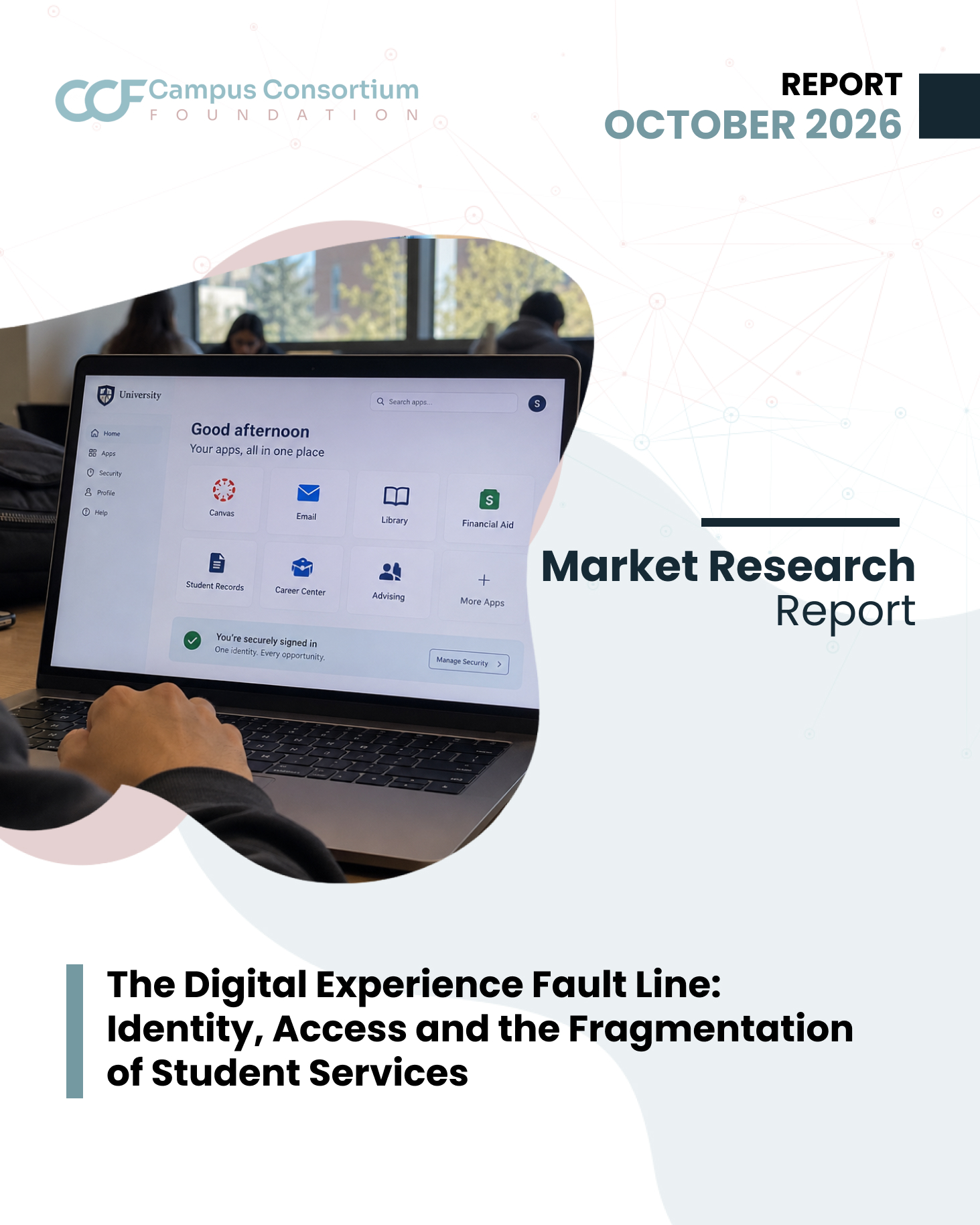
The Digital Experience Fault Line: Identity, Access and the Fragmentation of Student Services
Why Read This Research
Students face a fragmented digital experience as registration, financial aid, advising, and academic support remain scattered across portals and disconnected systems. U.S. districts can reach 3,001 digital tools, while 66% of surveyed college students reported navigating multiple platforms for one task and 47% missed an unknown deadline. Meanwhile, 52% of districts reported a cybersecurity incident in 2025, exposing the growing fault line between service delivery and student experience.
This research examines connected student services as a distinct education technology market, covering market size, adoption, technology maturity, vendor competition, governance, risks, and the 2026–2030 outlook. CCF estimates a potential U.S. college market of $39 million–$312 million annually by 2030, with a $146 million base case. These are planning scenarios, not forecasts. The research explores how connected systems can move beyond displaying links to coordinate workflows, exchange records, and deliver measurable improvements in student services.
Key Questions Answered
- How is digital fragmentation changing the way K–12 schools and colleges deliver services to students and families?
- How large is the connected student service opportunity, and what could the market look like through 2030?
- Which student-facing functions are most ready for integration, and where do significant adoption gaps remain?
- How are record-system providers, independent campus platforms, engagement systems, and institution-built solutions competing to become the primary student service layer?
- What evidence exists for improved service discovery, reduced administrative friction, stronger engagement, and better retention, and where does the evidence remain limited or vendor-driven?
- What identity, governance, privacy, accessibility, consent, and data-sharing controls are required to connect services responsibly?
- How could open data standards, application programming interfaces, shared case records, digital identity wallets, and AI-enabled service coordination reshape the category?
- Where are the largest market white spaces and strategic opportunities for institutions, technology providers, and investors through 2030?
Features
- Market Intelligence: Adjacent market estimates, connected-service market sizing, economic opportunity, adoption scenarios, market drivers, constraints, and the 2026–2030 outlook
- Student Experience Analysis: Registration, financial aid, advising, housing, health, career services, payments, attendance, family communication, and student support journeys
- Audience Segmentation: K–12 students, parents and guardians, college students, returning adult learners, staff, and advisors, with distinct service needs and institutional buying centers
- Technology Maturity: Shared sign-in, digital front doors, cross-system data exchange, shared case records, deadline and hold outreach, and service analytics
- Vendor Landscape: Record-system-integrated portals, independent campus applications, engagement and customer relationship management platforms, and institution-built connective layers
- Governance & Identity: Shared authentication, account lifecycle management, delegated guardian access, consent rules, role-based permissions, common records, auditability, and controlled vendor access
- Economic Analysis: College-level revenue scenarios, adoption assumptions, contract-value sensitivity, break-even analysis, retention economics, and the institutional value of reduced service friction
- Evidence & Impact: Service awareness, advising utilization, missed deadlines, time spent finding information, student satisfaction, hold-resolution time, and limitations in measuring integration outcomes
- Risk & Regulation: Student privacy, children's data protection, accessibility compliance, cybersecurity exposure, vendor concentration, data portability, institutional ownership, and implementation risks
- Emerging Technologies: Open data exchange, interoperable identity, digital identity wallets, shared service records, workflow automation, AI-enabled coordination, and analytics for identifying student friction
- Market Opportunities: Unified student front doors, cross-office case management, automated deadline outreach, integrated financial aid and registration workflows, shared services for smaller institutions, and independent outcome benchmarking
- Future Outlook: Identity consolidation, integrated front doors, shared records, cross-office case coordination, measurable service outcomes, vendor consolidation, and the evolution of connected student services through 2030