Market Research Report
09/25/2026
Campus Consortium Foundation
The Autonomous Campus Shift: Redefining How Institutions Deliver Student Support
Why Read This Research
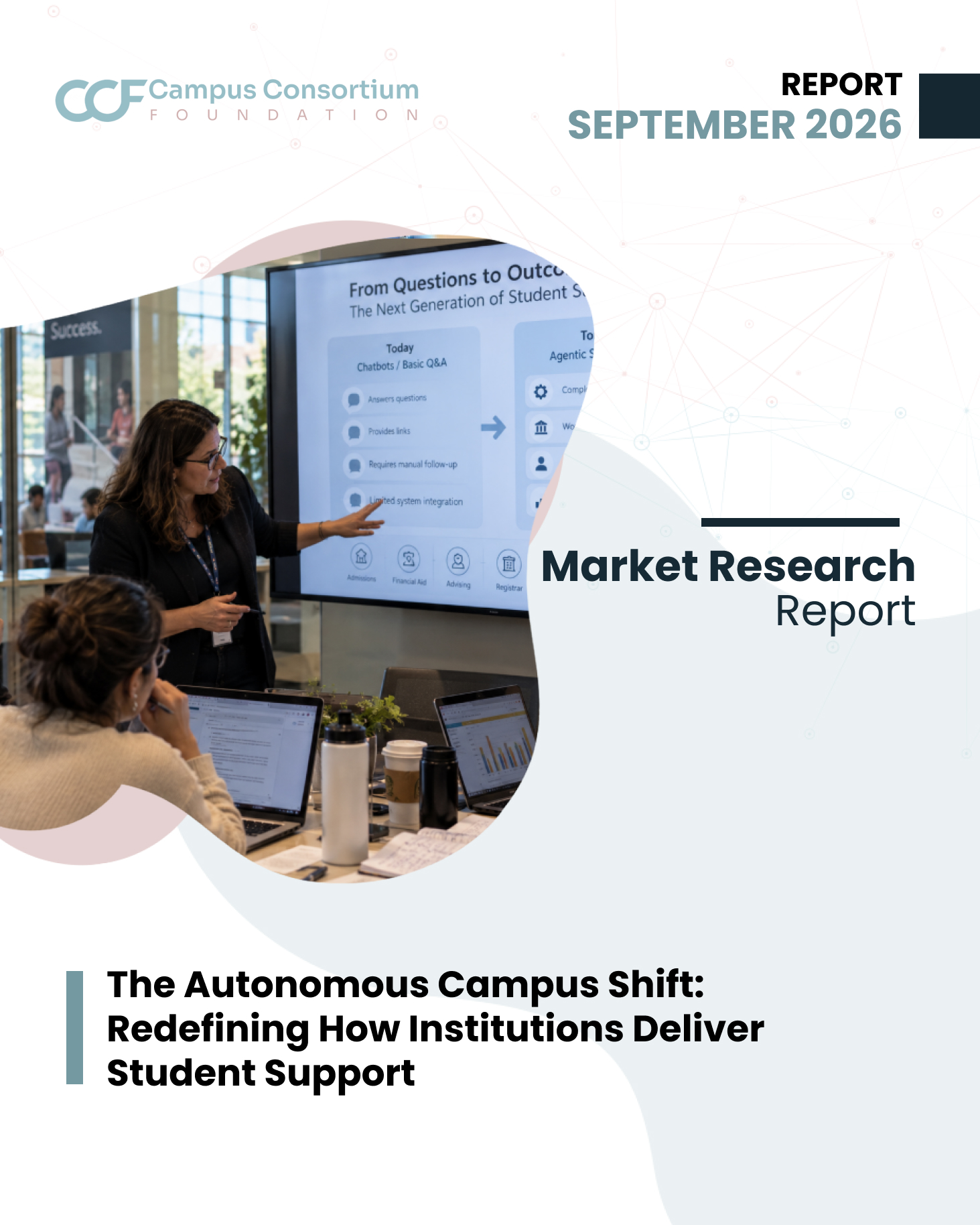
Higher education is moving from AI that simply answers questions to agentic systems that can complete student-service tasks, work across offices, and escalate complex cases to people. This shift is changing how institutions think about student support, staffing, technology, and investment.
This research examines the market size, technology maturity, vendor landscape, institutional demand, evidence, risks, and outlook for agentic student support through 2030.
Key Questions Answered
- What is driving the shift from chatbots to agentic student support?
- How large is the market, and where is it heading through 2030?
- Can AI actually complete student-service workflows—not just answer questions?
- Which student services are adopting agentic AI fastest?
- How mature are institutions in moving from conversational AI to autonomous workflows?
- What evidence shows that agentic AI improves enrollment, service delivery, or staff capacity?
- How should institutions evaluate vendors, integration, governance, and financial durability?
- Where does human judgment remain essential as AI becomes more autonomous?
- What regulatory, privacy, accessibility, liability, and governance risks should institutions consider?
- What opportunities and white spaces are emerging for institutions, vendors, and investors?
- What could accelerate or slow the market through 2030?
These questions are directly supported by the report's coverage of market size, maturity, institutional demand, vendor evaluation, case evidence, risks, opportunities, implementation, and the 2026–2030/31 outlook.
Features
- Market Intelligence: Market size, growth, adoption, segmentation, drivers, and 2030 outlook
- Technology Analysis: Agentic workflows, multi-agent orchestration, write-back, proactive support, voice, and governance technology
- Vendor Landscape: Higher-ed specialists, CRM/ERP platforms, infrastructure providers, and workflow-specific agents
- Buyer Guidance: Vendor evaluation, integration, evidence, compliance, implementation, and commercial considerations
- Institutional Fit: Analysis across research universities, four-year institutions, community colleges, HBCUs/MSIs, online institutions, and different deployment models
- Case Evidence: Documented examples of enrollment, admissions, financial-aid, workflow, and staff-capacity outcomes
- Future Outlook: Market trends, emerging technologies, white spaces, risks, implementation priorities, and 2026–2030/31 scenarios