White Paper
08/19/2026
Campus Consortium Foundation
The Economics of 24/7: What Round-the-Clock Student Support Really Costs (and saves)
Why Read This Research
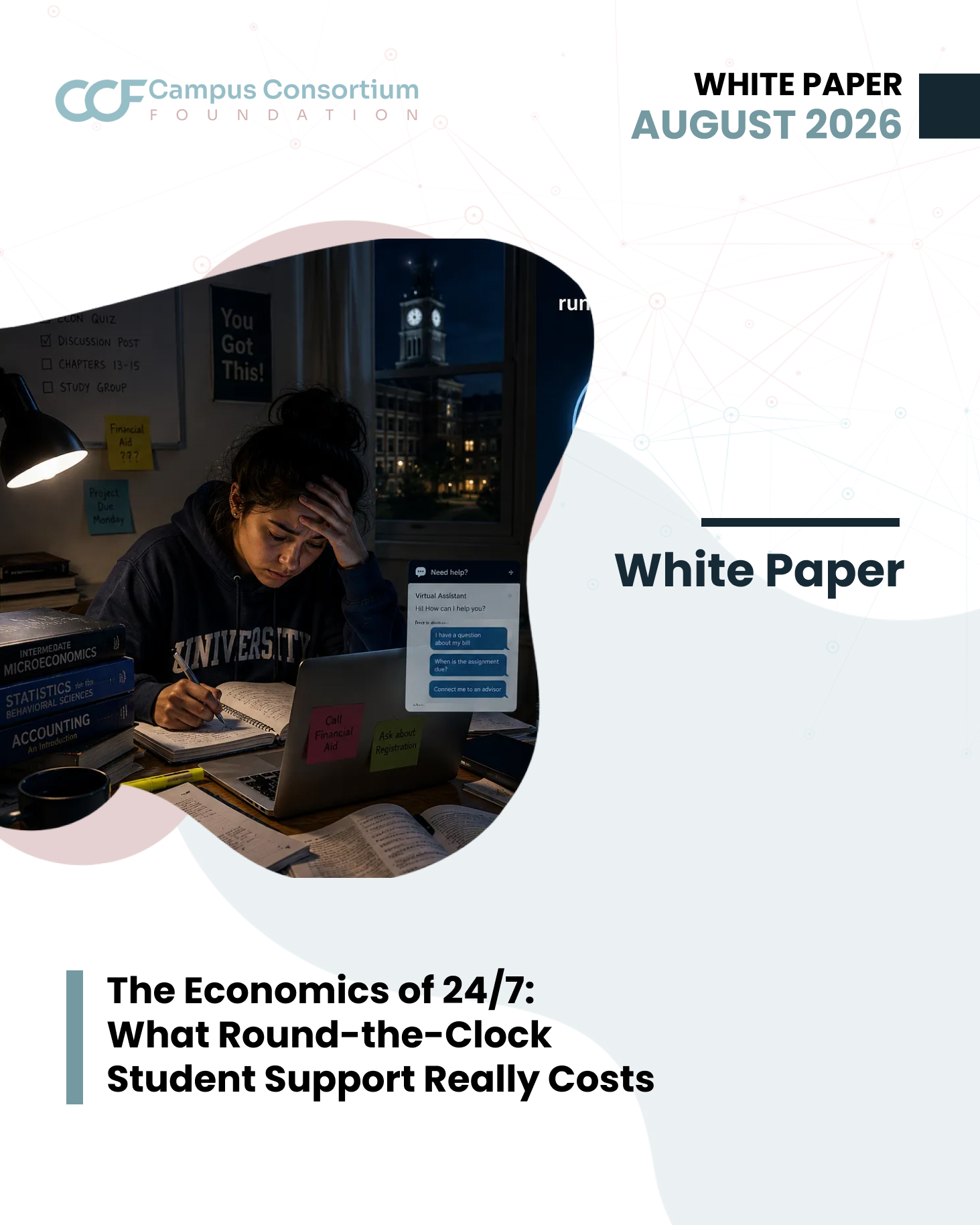
Student support needs no longer fit neatly into a 9-to-5 schedule. Online learning, working students, deadline-driven needs, and after-hours well-being concerns are widening the gap between when students need help and when institutions are available.
This research examines the financial case for expanding student-support availability, including the cost of unmet demand, student attrition, and traditional human-only coverage. It also introduces the AI Shared Services Maturity Model, a practical framework for moving from business-hours support toward affordable, always-on student services.
Key Questions Answered
- Why is the traditional 9-to-5 support model increasingly misaligned with student needs?
- What is the financial cost of unmet after-hours demand and student attrition?
- When do students actually need support, and which functions experience the greatest after-hours demand?
- Why does traditional human-staffed 24/7 coverage remain difficult to sustain?
- How do AI, self-service, co-sourcing, and shared services change the economics of continuous support?
- What does an effective 24/7 student-support operating model look like?
- Where does your institution sit on the AI Shared Services Maturity Model?
Features
- Research Focus: Student Support, Retention, AI, Shared Services, Student Experience, Operational Efficiency
- Future Campus Impacts: Retention, Enrollment, Student Well-Being, Workforce Capacity, Cost Reduction, Digital Transformation
- Authors: Campus Consortium Foundation Research Team
- Research Availability: August 2026
Table of Contents
- Executive Summary
- The Industry Challenge: A 24/7 Student Body, a 9-to-5 Support Model
- Service Availability: When Students Actually Need Help
- Student Expectations: The Consumer Baseline and the Awareness Gap
- Why the Gap Persists: The Institutional Bind
- Cost Avoidance: The Largest Line-Item Institutions Don't See
- Operational Efficiency: Channel Economics and Models That Scale
- Operational Reality: The Gap, Function by Function
- The AI Shared Services Maturity Model
- The Economic Test: A Decision Framework
- Future Outlook: Toward the AI-Native Institution